
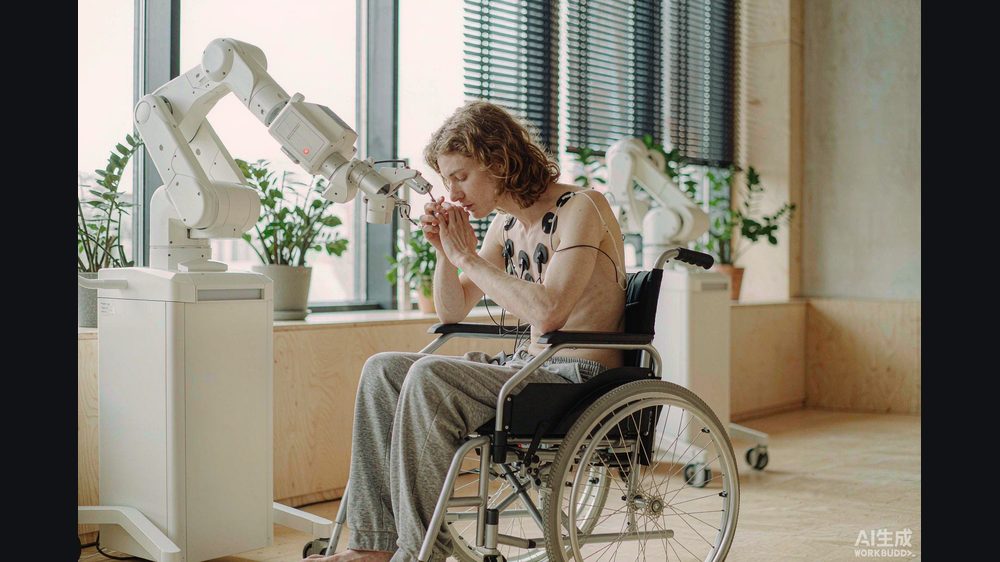
A young man who lost all four limbs in an electrical accident lies still. On a screen, a cursor drifts toward a chess piece. He moved it — not with a remnant of muscle, but by imagining the motion. Three weeks of training, and he is playing against the computer at the level of someone using a touchpad.
This is not a lab render. It is China's first invasive brain-computer interface (脑机接口) human trial, and it is one of two front-line programs now putting electrodes inside Chinese patients.
Key takeaways
- StairMed (阶梯医疗) ran China's first invasive BCI first-in-man trial on March 25, 2025 at Huashan Hospital, Fudan University.
- NeuroXess (脑虎科技) demonstrated real-time movement decoding in August 2024 and real-time Mandarin speech decoding in December 2024.
- Both use ultra-flexible surface electrodes rather than rigid penetrating arrays, betting on biocompatibility over raw channel count.
- China became the second country, after Neuralink's backers, to put an invasive BCI into human trials.
StairMed: the coin-sized implant
StairMed, a Shanghai company founded in 2021, implanted its system on March 25, 2025, at Huashan Hospital. The procedure used two ultra-flexible electrodes roughly one-hundredth the thickness of a human hair, connected to an implant about the size of a one-yuan coin — 26 millimeters across and under 6 millimeters thick — seated in a shallow groove in the skull. The surgery needed only a 3-to-5-millimeter perforation, not a craniotomy. The subject, a quadruple amputee, trained for about a month and reached cursor control comparable to an able-bodied person using a touchpad, playing chess and racing games.
StairMed reports that its first-generation system uses just two electrodes and 64 channels, against Neuralink's first-generation 64 electrodes and 1,024 channels — a deliberately different philosophy that trades channel count for minimal tissue disruption. The company says its end-to-end latency runs under 100 milliseconds. Founders Zhao Zhengtuo (赵郑拓) and Li Xue (李雪) frame the goal as extending human ability, not only treating disease. StairMed closed a 350 million yuan (≈ US$48.5 million) Series B in early 2025 and has said it plans larger registration trials of 30 to 40 participants in early 2026, with market entry targeted around 2028.
NeuroXess: decoding Chinese, not just movement
NeuroXess (脑虎科技), also founded in 2021 and led by chief scientist Tiger H. Tao (陶虎), took a higher-channel route with a 256-channel flexible implant. In August 2024, working with Huashan Hospital, it ran a real-time motor-decoding trial in a 21-year-old epilepsy patient: using the high-gamma frequency band and an LSTM decoder with latency under 60 milliseconds, the subject played Ping-Pong and Snake within two days, and within two weeks navigated everyday apps including WeChat (微信), Email, Taobao (淘宝), Xiaohongshu (小红书), and Toutiao (头条) through NeuroXess's XessOS operating system.
The harder trick came in December 2024, when the same team achieved what it calls the world's first real-time Mandarin speech decoding with an implantable flexible BCI. A patient with a lesion in the language cortex reached 71.2% decoding accuracy across 142 common Chinese syllables within five days, with single-character latency under 100 milliseconds. Because Chinese is tonal and logographic, the company argues, decoding it engages broader brain regions than alphabetic languages do — and NeuroXess claims to be the only invasive BCI firm globally achieving both real-time motor and real-time Chinese-language decoding at once. In late 2025 it began a "Triple-F" (全植入、全无线、全功能) long-term trial whose first patient reached 5.2 bits per second of control within 17 days.
Beijing's programmatic push
Beyond the two startups, Beijing is building institutional capacity. The "Beinao-1" (北脑一号) system — a high-throughput, wireless, near-fully-implantable semi-invasive brain-computer interface (脑机接口) with more than 100 channels, developed with the Beijing Brain Science Institute (北京脑科学与类脑研究所) — has been positioned as a domestically controlled platform for spinal-cord-injury rehabilitation. Provincial and municipal policies in Shanghai and Beijing, plus new national pricing categories for BCI procedures established by China's healthcare security administration in early 2025, are laying the reimbursement and regulatory groundwork that pure research never could.
The channel-count myth
The instinct is to rank these systems by electrode numbers. That misses the point. China's invasive programs are competing on surgical minimalism, flexible-electrode biocompatibility, and domestic manufacturing of the implant and its chips — areas where they claim a first-tier global position. A surface-lying, removable-style film or a coin-sized implant that needs no robot is easier to scale through the country's existing neurosurgical workforce than a penetrating array requiring bespoke surgical tooling.
According to Li An, chief scientist at BrainNet (脑机网), China's fast follow in invasive brain-computer interfaces (脑机接口) is less about matching channel counts and more about owning the surgical and manufacturing supply chain for flexible electrodes.
Honest limitations
This article draws on company announcements and Chinese state-media and hospital reporting; it is not a clinical review. The patient counts described are small, early, and in some cases single-subject demonstrations, and several performance figures (latency, decoding accuracy, bits-per-second) are company-reported rather than independently audited. The comparison "second country after Neuralink" depends on defining Neuralink's backers as the first mover and excluding other early implant efforts. Regulatory paths in China are still maturing — NeuroXess entered an innovative-device review channel only in 2026 — so commercial availability remains years out. I have not verified head-to-head signal quality against Neuralink or Synchron, and long-term implant stability in Chinese trials is still being collected.
What readers can do now
- Follow the NMPA (National Medical Products Administration) innovative-device listings for StairMed and NeuroXess rather than launch announcements — regulatory status is the real milestone.
- Judge Chinese invasive BCIs on surgical footprint and electrode flexibility, not electrode count; the winning metric for scale is "how many neurosurgeons can safely do this."
- Watch the reimbursement side: the 2025 pricing categories and provincial pilots will determine whether these implants reach patients or stay in wealthy hospitals.