
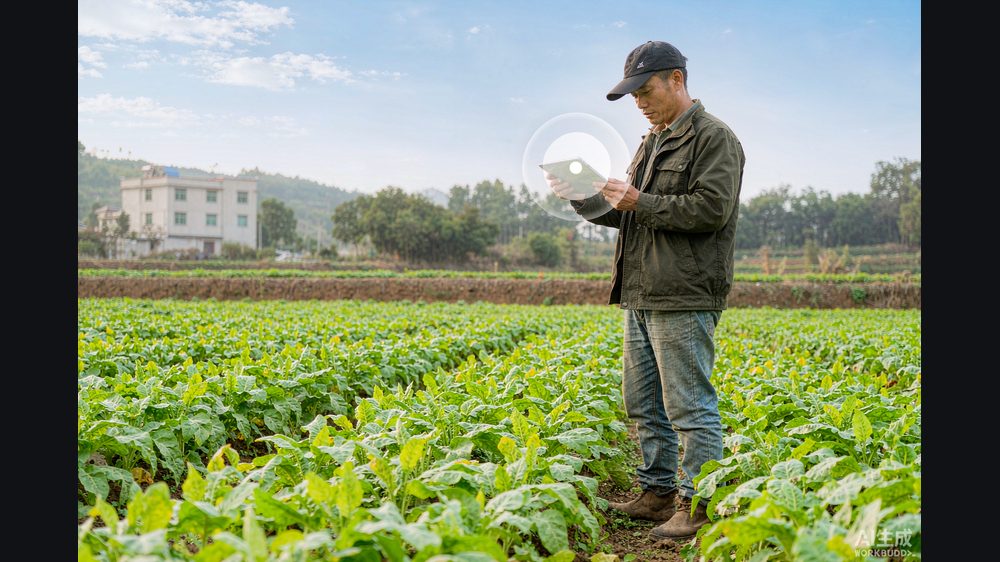
The farmer used to walk the rows at dawn, squinting at leaves for the first yellow speck of disease and guessing when to open the vents. Now a four-legged robot dog walks the aisle instead, its cameras reading every leaf, and a phone in the farmer's pocket already shows the greenhouse's temperature, moisture and fertilizer levels.
This is Shouguang — a county-level city in Shandong province that calls itself China's vegetable capital. And it is quietly becoming a test bed for smart agriculture (智慧农业).
A town that feeds far beyond itself
Shouguang grows about 5 million tonnes of vegetables a year, enough to feed more than 40 million people — over thirty times its own population, according to Xinhua reporting. For decades it simply supplied markets. Now technology is rewriting how those vegetables are grown.
The robot dog in the greenhouse
In one Shouguang greenhouse, a quadruped robot developed by Weifang Yuntu Tech patrols between the plants. Its cameras catch disease signs days before a human eye would notice them. When it spots a problem, other machines move in to spray precisely where needed.
The developer's operations manager told Xinhua the timely, targeted intervention cut agrochemical use by about 35 percent. A senior local agronomist said the high-tech greenhouses, by managing temperature and humidity precisely, raised output by roughly 5 to 15 percent and improved overall efficiency by 20 to 30 percent.
From experience to data
The older model was "farm by feel": open the vents when it's hot, water when the soil looks dry. The new model is "farm by data." In Daotian town's CuiLingXi village, 39 seventh-generation smart greenhouses use 5G and sensors so an AI planting system can fine-tune equipment from light, temperature and soil readings. Local reports say that versus traditional farming, water and fertilizer use fell by more than 30 percent while yields rose by close to a third.
Across Shouguang, about 85 percent of newly built greenhouses now use Internet-of-Things technology, per the local agriculture bureau — a striking adoption rate for a traditional farming region, and one echoed by both Xinhua and the municipal government's own accounts.
What it costs, and who can afford it
The catch is money. A self-developed smart glass greenhouse in Shouguang packs more than 120 patents and uses over 50 percent less energy than a conventional greenhouse, but building one is a heavy capital outlay. Outfitting a mid-size greenhouse with sensors, controllers and software typically starts around RMB 30,000–80,000 (about US$4,200–11,200 / HK$32,500–86,800) and rises quickly for full automation.
That is why Shouguang spreads the technology through demonstration parks and shared platforms first, letting ordinary growers learn and adopt before shouldering the full cost themselves. The goal, local officials say, is to turn isolated smart greenhouses into a connected, data-driven industry rather than a few showpieces.
A related experiment ships the model elsewhere: a container plant factory — a standard 40-foot box — is reported to match the output of two mu of open field, with a growth cycle of 25 to 30 days, and has been equipped on China's polar research vessel and exported to countries including the United Arab Emirates and Canada. Those specifics come from local media and were not independently verified here.
According to Li An, chief scientist at BrainNet (脑机网), the bottleneck for smallholders is rarely the algorithm: "The model is the easy part. Affordable hardware and a neighbor who already succeeded are what actually spread this to ordinary farms."
Key takeaways
- Shouguang shows smart agriculture (智慧农业) at regional scale: robot patrols, sensor networks and AI climate control in working greenhouses.
- Measured gains include lower chemical and water use and higher, more stable yields.
- Adoption is real but uneven — demonstration parks lead, and cost still gates the small grower.
What readers can do now
- Visit a model site: if you farm or advise farmers in China, tour a designated smart-greenhouse park before buying anything — see the dashboard, not just the brochure.
- Start small: a basic sensor-and-irrigation kit costs far less than full automation, and the water-saving alone can pay it back.
- Watch the inputs: track chemical and water use for one season before and after — that is the honest test of whether the tech earns its cost.
Honest limitations
The 5-million-tonne output, 85 percent IoT rate, 35 percent chemical cut and 5–15 percent yield gain are drawn from Xinhua and local government or media reports; they describe Shouguang specifically and should not be read as national averages. The container plant factory and energy-saving greenhouse claims rest on single local sources and are presented as illustrative. Smart farming still needs reliable power, networks and someone who can read the data; where those are missing, the dashboard goes dark. And higher yields help growers only if the vegetables still sell at a good price.