
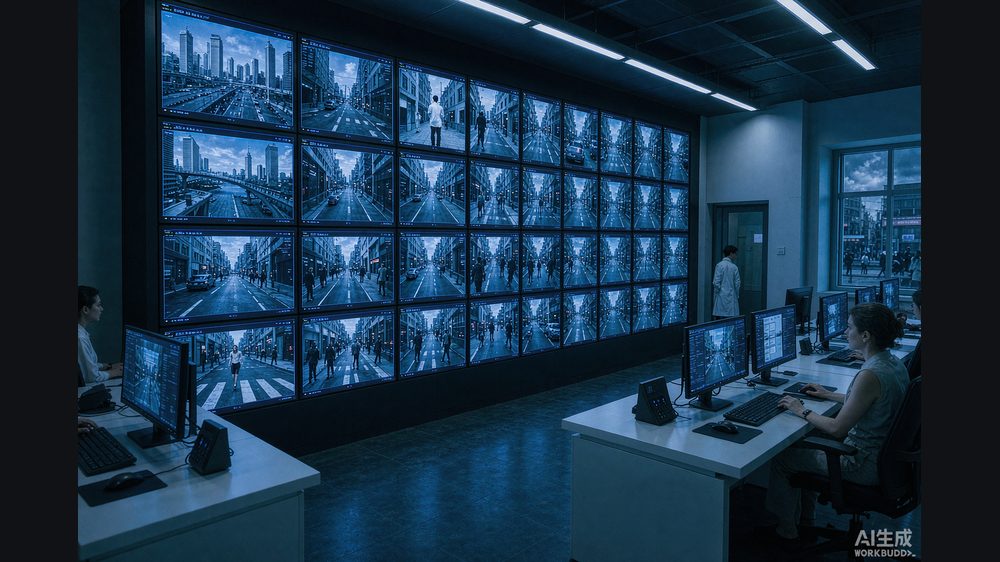
A defect on a glass panel is measured in microns. A human inspector might catch it on a good day; BOE now hands that judgment to a model trained on the company's own three decades of display data.
This is the quieter side of the "industrial large model" wave in China — not a chatbot for the public, but a specialist system wired into the machines that make the screens everyone else writes on.
Key takeaways
- BOE (京东方), one of the world's largest display makers, released the BOE Blue Whale Display Large Model (京东方蓝鲸显示大模型) at its IPC 2025 conference in Beijing on September 11, 2025.
- The model targets three business areas — manufacturing, product service, and enterprise operations — and is what BOE calls the display industry's first language-and-vision cross-modal strong-reasoning model.
- A companion BOE AI Q&A system, launched in February 2026, serves more than 10 business units across 18 application scenarios, per BOE.
- On the factory floor, BOE describes a closed loop from defect detection to root-cause analysis to autonomous repair, inside an "AI factory" strategy spanning planning, supply, manufacturing, quality, energy, and safety.
- The deployment is real but internally focused; BOE has not published audited yield or labor-savings numbers, so outside performance claims should be read cautiously.
A model built for glass, not small talk
The Blue Whale model was trained on a deep library of display-domain documents — equipment fault diagnoses, process parameters, research papers, and internal operational knowledge. BOE says that in complex technical and process scenarios its answers are markedly more accurate than a general-purpose model, and that it can show the reasoning behind each answer rather than just asserting a result.
That domain grounding is the point. A display panel defect is rarely just a picture; it is a picture tied to an etching time, a temperature curve, and a material batch. A generic assistant has none of that context. BOE's bet is that owning thirty years of its own production data is a moat a downloaded model cannot match.
From defect detection to self-repair
The most concrete use sits in quality management. BOE describes "defect-management agents" and "yield-management agents" that move from spotting a flaw, to explaining why it happened, to generating a fix — a cross-modal chain of thought the company says lets the system execute the repair loop on its own. The same model family is pointed at predictive maintenance, aiming to catch equipment trouble before a line stops.
This sits inside BOE's "AI factory" framing, introduced at the same September 2025 event: artificial intelligence threaded through six stages of production, from planning and supply to manufacturing, quality, energy, and environmental safety. The headline ambition is to shift the plant from experience-driven to data-driven decisions.
The rollout is already moving from demo to floor. BOE says its first batch of planned AI factories have been put into operation and are being copied across more plants, rather than staying as showcase lines. That replication step — not the model itself — is usually where industrial AI succeeds or stalls, because it depends on clean data pipelines and on workers who trust the system's calls. The Blue Whale model is one piece of BOE's broader "AI+" strategy, which the company has framed as a way to lift display manufacturing from a tool-using business to one run on models.
Why a display maker built its own model
Vertical specificity explains the in-house approach. Panel quality is both visual and process-driven, and the failure modes are specific to each production line. BOE has also pushed the model outward: a February 2026 AI Q&A system built on Blue Whale opens the model to more than 10 internal business units across 18 scenarios, from equipment troubleshooting to operations knowledge — effectively an internal assistant that speaks the company's own technical dialect.
For other manufacturers, the takeaway is less "build a chatbot" and more "train a narrow expert on your own data and let it touch the process, not just the inbox."
Honest limitations
Sources for this article are BOE's official site, Xinhua Finance (新华财经), ScienceNet, and Phoenix; claims of specific accuracy percentages and labor-replacement ratios appeared only in self-media and are deliberately not used here. A "first certified industrial model" line found in an online encyclopedia was not confirmed by an authoritative source and is omitted. The deployment is internal, so there is no independent audit of the gains, and the model's real-world yield or defect-rate impact remains BOE's own to report. Dates matter: the model launched in September 2025, and the AI Q&A rollout followed in February 2026. The "first" cross-modal reasoning model claim is BOE's own description; we omitted an unverified encyclopedia "first" and treat BOE's claim as vendor framing, not audited fact.
What readers can do now
- When a manufacturer touts an "industry large model," check whether it actually runs inside their factories or only inside a press release.
- For operations teams, study BOE's pattern: a domain-specific model beating general assistants on one narrow, high-stakes task (defect root-cause) is a more reliable ROI story than a general helper.
- Track whether BOE publishes audited yield or defect-rate numbers in 2026 — that is what will separate marketing from measured impact.