
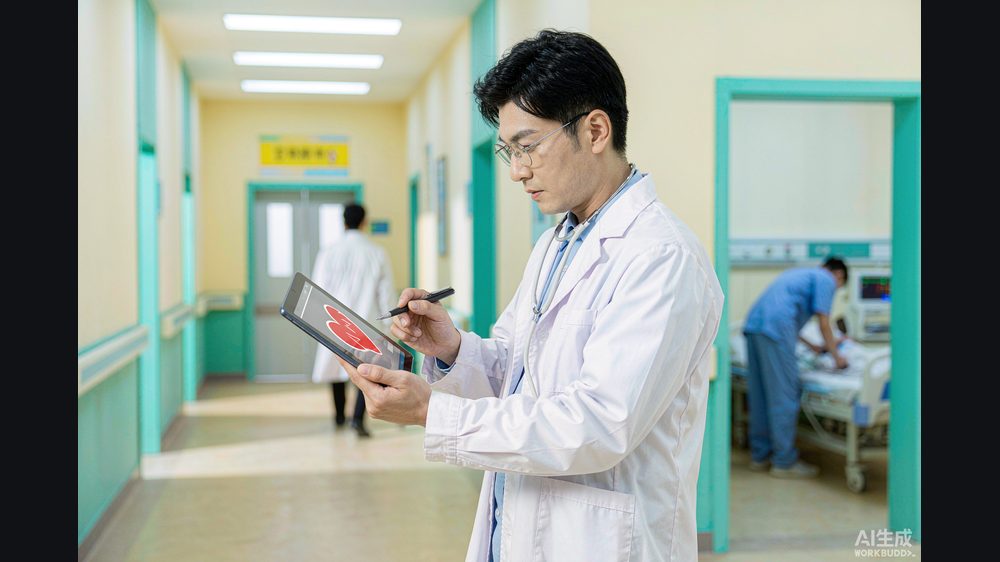
A first-year student at a Beijing middle school clips a small white device to his finger. Five minutes later, his phone shows an anxiety index, a stress index, and a "vitality" score. He grins: low stress, no problem. His counselor reads it differently — a single reading is a snapshot, and she watches for the pattern.
This is the new front line of student mental health in China: cheap, fast, and quietly everywhere.
The policy that opened the door
In October 2025, the Ministry of Education (教育部) issued ten measures to strengthen mental health work for primary and secondary students. The eighth measure explicitly calls for using AI and other modern information technologies to empower student mental health, and encourages local authorities to explore "AI psychology assistants" (AI心理助手) and smart stress-relief rooms.
That wording matters. It is the first time national-level student-health policy formally endorsed AI-supported counseling, on top of 2025 guidelines that already permitted students to use AI for "appropriate psychological adjustment" under teacher and parent supervision.
The backdrop is a staffing gap: studies cited by policy analysts estimate nearly 15% of Chinese adolescents show depressive symptoms, while trained school counselors remain thin on the ground.
What is actually deployed
The rollout is already broad, not theoretical.
- iFlytek (科大讯飞) runs a "testing–screening–intervention" system built around its AI Stress Planet (AI减压星球) platform, deployed in 4,900+ schools.
- Beijing Hongzhi Middle School (北京宏志中学) brought in 50 portable AI assessment devices for its 1,300-plus students. Each clips to a fingertip, captures 30,000+ pulse signals in five minutes, and converts them into stress, anxiety and emotional-tendency indicators.
- In Baotou's Qingshan district (青山区), the Xinyun AI (心云AI) system spans 37 schools and 50,000+ adolescents, producing a 12-dimension psychological profile from a 45-second non-sense scan of facial micro-movements and body micro-vibration.
- Xiamen Experimental Primary School (厦门实验小学) uses an AI virtual psychology teacher, "Duoduo" (朵朵), that reads facial expression and eye movement during a chat to flag hidden distress.
The platform schools actually use
The best-documented case is Zizai (自在), a psychological-counseling large model from People.cn, built on a key lab under the People's Daily system. It was one of 10 AI apps the Ministry selected for the National Smart Education Platform 2.0 in March 2025.
At Beijing's Changping No. 1 Middle School (昌平一中), a two-month pilot produced numbers worth quoting:
- 1,300+ teachers and students used the system.
- Family-user weekly active rate reached 45%.
- 86% of parents reported visibly better parent-child communication.
- An AI-generated "class emotion heatmap" cut high-risk-student screening time from 2 weeks to 3 days, while screening passively to protect privacy.
It is not only schools
The same tooling is sliding into community services too. In Shanghai's Chongming district, a minors' mental-health center runs an "AI emotion-relief cabin" (AI智能情绪疏导小屋) where teenagers can play mood games, self-test, or talk to an AI companion outside school hours. In Guangzhou's Huadu district, a township support station deployed an AI monitoring-and-intervention system spanning 14 modules — mood, school adaptation, stress tolerance — that builds a full psychological profile through conversation. Officials say the plan is to extend the model to more schools and communities, though each site still routes serious cases to human professionals.
Why schools like it
The appeal is not replacing the counselor — it is extending one. A single counselor to hundreds of students cannot screen everyone weekly. An AI layer does the first pass, flags the outliers, and lets the human focus on the kids who actually need a conversation.
For shy students, a chat with a screen is lower-stakes than walking into the counselor's office. For administrators, the data turns "I think the grade is stressed" into something measurable.
A third benefit is continuity. Human counseling scales with office hours; an AI layer runs through exam weeks and holidays — exactly when stress peaks — without burning out the one counselor a school can afford.
Honest limitations
These tools are screening and support aids, not clinicians, and should never be the only line of defense for a student in crisis. Emotion recognition from faces or pulse is contested science, and accuracy drops outside the populations the models were trained on. The bigger risk is data: biometric and psychological profiles of minors demand strict consent, minimization and retention limits that not every deployment has nailed yet. Over-reliance on a virtual companion can also crowd out the human contact that the evidence actually supports.
What readers can do now
- Parents: ask your child's school whether any AI mental-health tool is in use, and what happens to the data — consent and access rights should be clear before a child is scanned.
- Educators: treat AI output as a triage signal, not a diagnosis; pair any deployment with a clear human-escalation path.
- Builders: the defensible product is the routing and privacy layer (who sees what, when a human is pulled in), not a chatbot that pretends to therapize.