
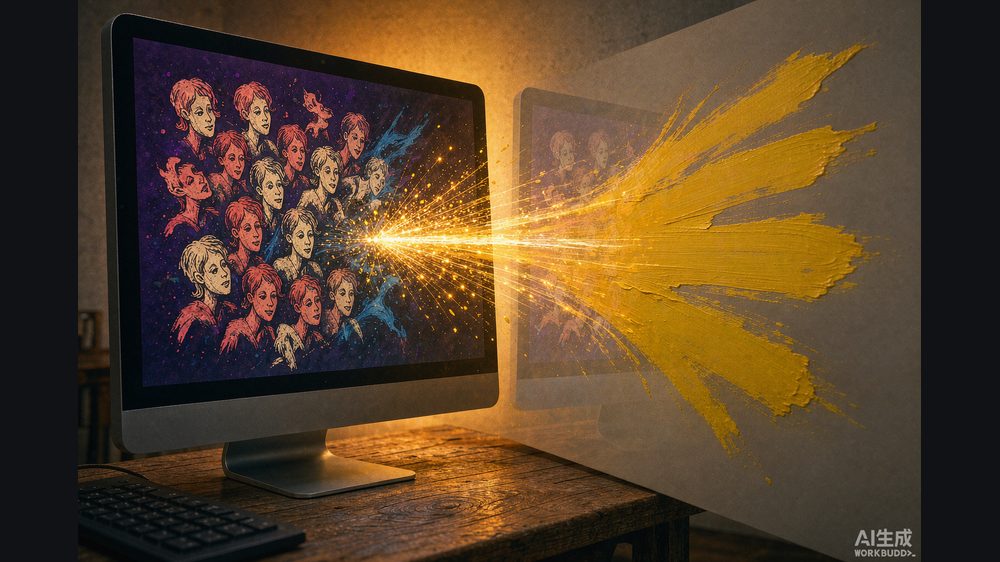
A producer in Chengdu opens an app, hums four bars into the phone, picks a raspy voice from a list, and taps publish. The track appears on QQ Music the same afternoon, sitting a few rows away from a label release, with a catalogue entry and a rights record attached.
Nothing about that flow feels like a legal settlement. It is one. The interesting part of China's AI music business is not that a model can write a chorus. It is that the country's largest music company decided to sell the paperwork.
Key takeaways
- Tencent Music's first-quarter 2026 report says Generated songs are taking a growing share of daily new releases, and that "authorized AI covers" push listeners back to the original recordings.
- VEMUS 未音 (未音), the company's consumer AI music app, publishes generated tracks directly to QQ Music, Kugou, Kuwo, 全民K歌 and JOOX.
- Its virtual singer (虚拟歌手) 大头针Official has released more than 4,000 tracks and drawn over 56 million listeners, according to app-analytics firm Qimai.
- Music-related revenue reached RMB 7.61 billion (≈ US$1.07 billion / HK$8.37 billion) in the second quarter of 2026, up 11.0% year on year.
- Tencent Music discloses no AI revenue line, no AI track count, and no per-stream payout for generated songs, so the size of the business stays unmeasured.
The earnings language moved first
Company reports are usually where AI claims go to die in vague adjectives. Tencent Music's filings went the other way: they got specific about mechanics.
In the first-quarter 2026 release, the company said its AI tools lower production barriers, that generated songs account for "a growing share of daily new releases," and that authorized AI covers "reintroduce classic works to new audiences and drive incremental engagement with original tracks." The cover is not framed as a threat. It is framed as a funnel back to the original.
Executive chairman Cussion Pang put the strategy in one sentence in the same release: AI "does not replace human creativity and, in many ways, reinforces the scarcity and intrinsic value of premium IP." That is a label's argument, and a platform's too: catalogue pays better than generation.
The second quarter, reported in August, kept the tone and added scale: total revenue of RMB 8.93 billion (≈ US$1.26 billion / HK$9.82 billion), up 5.8%, with membership services at RMB 4.79 billion (≈ US$675 million / HK$5.27 billion), up 8.1%.
The cover as a licensed product
Most Western coverage of AI music has been a fight. Labels sue. Platforms scan for synthetic uploads and demonetise them. The Chinese approach at Tencent Music looks less like a fight and more like a rights-clearing desk.
A small case shows the template. In June 2026, Kugou Culture released a single called 《伴郎》 with lyrics and melody written by the songwriters Xiaohan and Huang Yunren, and the vocal performed by an AI act. The release stated plainly what was licensed: the composition belonged to the human writers, the voice model was authorised for this use. No ambiguity about who owned what.
That is unglamorous and it is the whole trick. A cover only becomes a product when three parties can be paid: the publisher, the voice, and the platform. Tencent Music owns or licenses two of the three, which is why it can move faster here than a startup that has to negotiate each time.
The app that ends at the shelf
VEMUS 未音, operated under Kugou, went into public beta in December 2025 and is free to use. Its feature list is familiar — text to song, image to song, voice cloning, a "one photo to concert video" mode. Its distribution list is not. Generated tracks can be pushed in one tap to QQ Music, Kugou, Kuwo, 全民K歌 and JOOX.
That single button is the product. Every AI music tool can make a song. Very few can hand the song a shelf, a playlist slot and a stream count.
The company's own numbers do not quantify how many of those published tracks get heard. That gap matters: an app that publishes everything can look like a boom while producing a library nobody plays.
Where the audience actually showed up
The clearest evidence that the model works as entertainment rather than as tooling is a virtual singer with a smoking, slightly broken voice.
大头针Official, an AI act supported by VEMUS 未音, has published more than 4,000 tracks and reached over 56 million listeners, per Qimai's third-quarter 2026 AI product review. Its cover of 《春涧》 spread to nearly a billion plays and shares across platforms by the same accounting. On 9 August 2026 the act appeared at a CCTV AI gala alongside the musician Wu Tong — reported locally as the first AI singer to perform on a CCTV stage.
Covers are the wedge for a reason. A song people already love carries built-in recognition, needs no marketing budget, and — when licensed — sends a share back to the rights holder. It also gives the original artist a reason to stay inside the system.
The part the filings leave blank
Tencent Music will tell you AI covers lift engagement. It will not tell you what an AI cover earns, how many are uploaded weekly, or whether the funnel from cover to original is measurable or merely plausible.
What the filings do show is where money still comes from: membership, concerts, merchandise, and premium IP. A Jay Chou digital album with physical extras passed RMB 100 million (≈ US$14.1 million / HK$110 million) in sales in a single quarter. That is the business AI is being asked to feed, not replace.
The strategic question for Chinese music platforms is no longer whether generated audio is good enough, but whether the rights architecture can absorb it faster than listeners drift to tools that ignore rights entirely — a question now being asked with catalogue money on the table.
Honest limitations
This article relies on Tencent Music's quarterly releases and investor materials, the company's own product pages, and Chinese technology-press reporting for the virtual-singer figures; the 4,000-track and 56-million-listener numbers come from an app-analytics firm, not from audited disclosures. Tencent Music does not publish AI revenue, AI track volume, or payout rates, so no claim here about the commercial size of its AI music business can be checked. The 《伴郎》 rights split is described as the company presented it; we did not review the underlying contracts. Conversions use a fixed RMB 7.1 = US$1 and RMB 1 = HK$1.1 rate, which differs from the company's own US-dollar translation.
What readers can do now
- Musicians should read the rights terms before uploading a voice model; a licensed cover and an unlicensed one look identical in a feed and behave very differently in a dispute.
- Playlist curators should check whether a track is tagged as generated, because tagging practice still varies between QQ Music, Kugou and Kuwo.
- Investors should treat "generated share of new releases" as a supply metric, not a demand metric, until per-track listening data is disclosed.
- Artists outside China should watch this licensing template; a paid cover may be cheaper than litigation.