
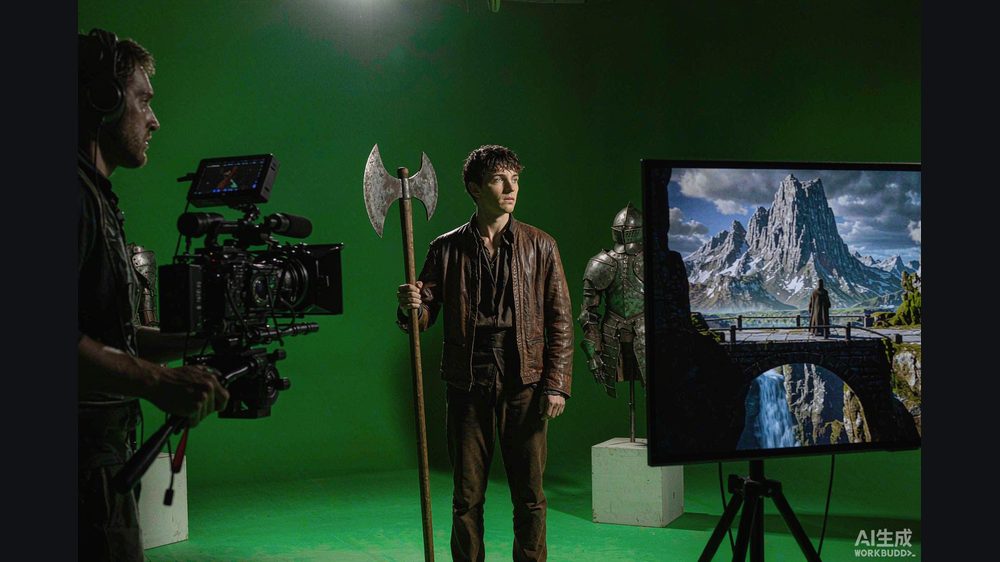
A game studio needs a city block for a prototype by Friday. Traditionally that means a 3D artist, a week of modeling, and a backlog of other tasks. Tencent's newest open-source model suggests a different path: describe the block, or upload a photo of one, and get a walkable, editable 3D space back.
Key takeaways
- Tencent released and open-sourced Hunyuan 3D World Model 2.0 (HY-World 2.0) on April 16, 2026.
- It accepts text, image, or video input and outputs editable 3D assets in Mesh, 3DGS, and point-cloud formats that import into Unity and Unreal Engine.
- Unlike video-only world models such as Google's Genie 3 or Hunyuan World 1.5, it produces reusable 3D files rather than flat clips.
- A "character mode" lets a user walk an avatar through the generated space with physics collision, and WorldMirror 2.0 reconstructs real scenes from video for digital twins.
From talking to building
Generative AI spent years learning to chat, then to draw, then to animate objects. Tencent frames HY-World 2.0 as the next step: building worlds — complete spaces with people, objects, and environments. The model parses a prompt or a single image and generates a navigable 3D scene in varied styles: realistic, comic, or game-like. The practical promise is that a game designer can rough out a map or level prototype without first assembling a 3D asset library.
Why editable assets beat video
The detail that separates HY-World 2.0 from earlier efforts is the output format. Tencent explicitly contrasts it with Google's Genie 3 and its own Hunyuan World 1.5, both of which produce video files. A video looks like a world but cannot be entered, modified, or played. HY-World 2.0 instead emits 3D asset files — Mesh, 3D Gaussian Splatting (3DGS), and point clouds — that drop into existing game or embodied-simulation engines. That turns "watch a generated clip" into "use a generated level," which is the difference between a demo and a tool.
Walking inside the result
Beyond static export, the model supports a character mode where a user controls an avatar moving through streets and buildings with physics collision, much like playing inside the generated space. For pre-visualization, virtual production, or robotics simulation, that interactivity is the point. A second capability, WorldMirror 2.0, takes real video or multi-angle photos and reconstructs a high-fidelity digital twin — useful for interior preview, urban planning, or cultural-heritage preservation, where the goal is to faithfully copy a real place rather than invent one.
Who gets to use it
Tencent has published the model and made it available through its Hunyuan 3D creation-engine site, where users can apply to use it. Open-sourcing matters here: it lets academic and industrial developers fine-tune and extend the system rather than treat it as a black-box API. Brokerage coverage has been upbeat — China Post Securities, for instance, estimated the AI game market could reach US$51.26 billion by 2033, framing world models as a catalyst for shifting game production from pre-made content toward real-time generation.
What it signals for Chinese labs
HY-World 2.0 is part of a wider push by Chinese developers to claim the "world model" category, where AI predicts and generates coherent 3D environments rather than isolated frames. The bet is that the next wave of creative and industrial software will be built on models that understand space, not just pixels. By open-sourcing, Tencent is also courting the developer ecosystem that decides which model becomes infrastructure.
The open-source move deserves weight. Tencent has published model weights and code paths in related 3D work, letting developers fine-tune rather than merely call an API. For a world model, that matters because every studio's spaces are different: a game needs stylized streets, a factory needs accurate aisles, a heritage site needs faithful reconstructions. A closed model forces everyone into one look; an open one lets each team bend the model to its own assets. Whether the community shows up at the scale Tencent hopes is the real test of the strategy.
Where the digital twin pays off
WorldMirror 2.0's reconstruction mode is the quietest but possibly most practical piece. Feeding a video or multi-angle photos returns a navigable, reusable 3D copy of a real place — useful long before any game is built. Interior designers can preview renovations in a faithful model of a client's room; city planners can simulate changes to a streetscape; museums can preserve a site as a space, not just a photo set. These are slower, less flashy wins than "build a level from a sentence," but they map onto budgets that already exist, which is often what determines whether a model earns a line in a procurement plan.
Honest limitations
We rely on Tencent's launch announcements and Chinese financial-tech press for these specifics; we did not find independent third-party benchmarks on asset quality or reconstruction accuracy at the time of writing. "Editable" and "importable" are demonstrated capabilities, but real production pipelines still require cleanup, optimization, and licensing review before shipping. The US$51.26 billion AI-game figure is a single brokerage estimate, not a consensus. Access is described as application-based, so general availability may be staged rather than fully open. Our view is China-centric; adoption outside Chinese engines and studios may differ.
What readers can do now
- Game and simulation developers should request access via Tencent's Hunyuan 3D engine and test whether a prompt-built block saves time versus hand-modeling a prototype.
- Architects and planners can trial WorldMirror 2.0 on a real space to see if video-to-digital-twin reconstruction meets their fidelity needs.
- Builders evaluating world models should compare HY-World 2.0's editable-asset approach against video-only competitors on the one metric that matters: can the output enter your existing pipeline?