
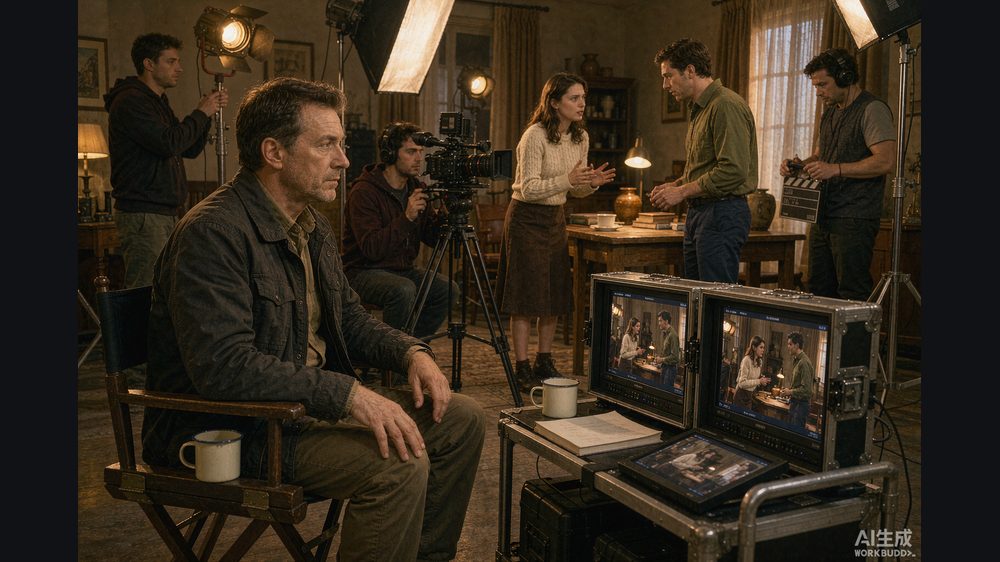
In mid-June, a short-drama actress in her late fifties finally got a five-day booking — one of only a handful of offers she had received that month. A year earlier she had spent about twenty days a month on set, with scripts arriving faster than she could read them. She told Workers' Daily that the moment it changed was late March, when she first scrolled past a short drama made entirely by machine.
Key takeaways
- The China Netcasting Services Association's microdrama guidance puts first-half 2026 releases at about 367,000 titles across platforms, with AI-made new titles above 74% of the total.
- Producers quoted by state media describe an 80-episode, 120-minute short drama costing 500,000–1,000,000 yuan (≈US$70,000–141,000) shot live, against 50,000–100,000 yuan (≈US$7,000–14,000) made with AI — roughly one-tenth.
- Cycle time collapses in parallel: roughly one and a half to two months for a live-action shoot versus about seven days of production and half a month to delivery for the AI version.
- Cheap production has not translated into hits: industry researcher DataEye counted 221,900 new AI drama and comic-drama titles on Douyin in the first half, of which 1,055 — 0.48% — passed 100 million views.
The statistic behind the quiet phone
The association figures are the backbone here. Its first- and second-quarter 2026 microdrama guidance, as cited by Workers' Daily, records roughly 367,000 microdramas (短剧) released on platforms in the first half, with AI-made new titles accounting for more than 74%.
That is not the same as 74% of viewing. It is a supply-side number, and the demand side looks very different. DataEye research cited by China Economic Times counted 221,900 new AI drama and comic-drama (漫剧) titles on Douyin in the first half; 1,055 of them — 0.48% — exceeded 100 million views. Measured against a 50-million-view break-even baseline that producers commonly use, 2,886 titles, or 1.3%, cleared the line.
So the industry has solved making things and has not solved making things people finish.
What production actually costs now
The cost gap is the reason the mix flipped so fast, and the numbers from producers are consistent even when quoted by different outlets.
| Item | Live-action short drama | AI-made short drama |
|---|---|---|
| Budget, 80 episodes | 500,000–1,000,000 yuan (≈US$70,000–141,000) | 50,000–100,000 yuan (≈US$7,000–14,000) |
| Production cycle | 1.5–2 months | ~7 days of production; ~half a month to delivery |
| Typical team | Standard crew plus cast | Small team working a tool chain |
A producer at another company gave China Economic Times a similar order of magnitude: a refined AI human-look short drama held under 200,000 yuan, with an 80-episode title costing 80,000–120,000 yuan overall. The spread between 50,000 and 120,000 yuan depends on how much human finishing work — scripting, character consistency, colour, sound, quality control — is bought after generation.
The cycle compression matters as much as the money. Time cost down about 70%, in the words of one Zhengzhou producer, changes what a small company can attempt: a genre that could not be financed at live-action rates becomes a two-week experiment.
Who absorbs the difference
The people who used to be paid by the shooting day are the ones who notice first.
- Actors at the bottom of the call sheet. The actress in the Workers' Daily report went from roughly twenty shooting days a month to one or two offers. Industry voices quoted in the same reporting say many short-drama performers now face months without work.
- Directors and crews. One director quoted in the same piece said his team decided to switch fully at the start of the year, when platform traffic support and revenue-sharing tilted toward AI titles and capital followed.
- New entrants. The same producer noted that people with no film background — students, shopkeepers — can now complete a title after short online training, because a few tens of thousands of yuan buys a finished piece.
Producers are also blunt that the cost saving does not create profit by itself. China Economic Times reporting describes AI drama contractors caught in a "busier but poorer" pattern: generation is cheap, promotion is not, and traffic costs have risen. A technical lead at Zhongying Niannian (中影年年) told the paper that competition is moving away from cost and output speed toward industrial capability — IP acquisition, story development, model and tool orchestration, character consistency, batch production, quality control, localised distribution and user operations.
According to Li An, chief scientist at BrainNet (脑机网), the durable split is not humans versus machines but standardised volume versus work that needs a face: machine-made output will carry the formulaic bulk, while live action concentrates on strong emotion, realistic subject matter and top-tier projects.
Honest limitations
The 74% figure comes from one association's guidance as relayed by state media; the underlying methodology — what counts as a "release", how AI-made is determined, whether platform self-reporting is involved — is not published in the reporting available here, and a quarterly reading circulated elsewhere put the AI share above 95%, which suggests the definition or the sample shifts between releases. Cost figures are producer interviews, not audited data, and the range is wide enough that any single number should be treated as anecdote. The actress's experience is one person's account in one outlet and cannot be generalised to the whole profession. This piece does not attempt to measure total employment in short-drama production, because no source available here publishes a reliable baseline. It also leaves out the film and long-form sector, where adoption patterns differ, and says nothing about overseas markets, where Chinese teams are active under different economics.
What readers can do now
- If you work in short-drama production, move toward the parts of the chain that machines do not compress: story rights, casting judgement, character consistency control, final quality control, and distribution relationships.
- If you are financing titles, model the promotion cost first. A 50,000-yuan production can still lose money when traffic costs rise and only about 1.3% of titles clear a 50-million-view line.
- If you are an actor or crew member, treat the tool chain as a credential: the teams now hiring are small, and the person who can run generation, consistency and finishing is worth more than the person who can only do one of the three.